Quick answer: Start with open, easy food games, reward curiosity and gradually introduce more movement without frustration. Start with the simplest safe step and adapt to your dog’s size, health, experience and comfort. This guide explains what to watch, what to do next and when professional help matters.
Dog owners often look for one fast fix, but the sensible plan begins by understanding why the problem happens. Small adjustments in preparation, environment and expectations can make the experience safer and more comfortable. The goal is progress without forcing a frightened, uncomfortable or unwell dog to continue.
This guide is written for everyday U.S. dog owners. It is educational rather than a substitute for veterinary care. For more background, explore Dogs Daily Care and the trusted resources linked at the end.
Table of Contents
What to know first
Start with open, easy food games, reward curiosity and gradually introduce more movement without frustration. Keep a simple record of what triggers the difficulty and which gentle changes help. If signs are sudden, severe or painful, contact your veterinarian rather than assuming a training or home-care issue.
1. Why some dogs ignore food puzzles
A food puzzle may be novel, noisy, confusing or simply too difficult. A dog who has always eaten from a bowl may not know that food is hidden in compartments. Some dogs are uneasy when objects wobble or scrape across the floor.
Refusal is not a sign of low intelligence. Begin by checking whether the dog is comfortable, hungry at the normal meal time and able to handle the pieces.
2. Choose the easiest possible starting point
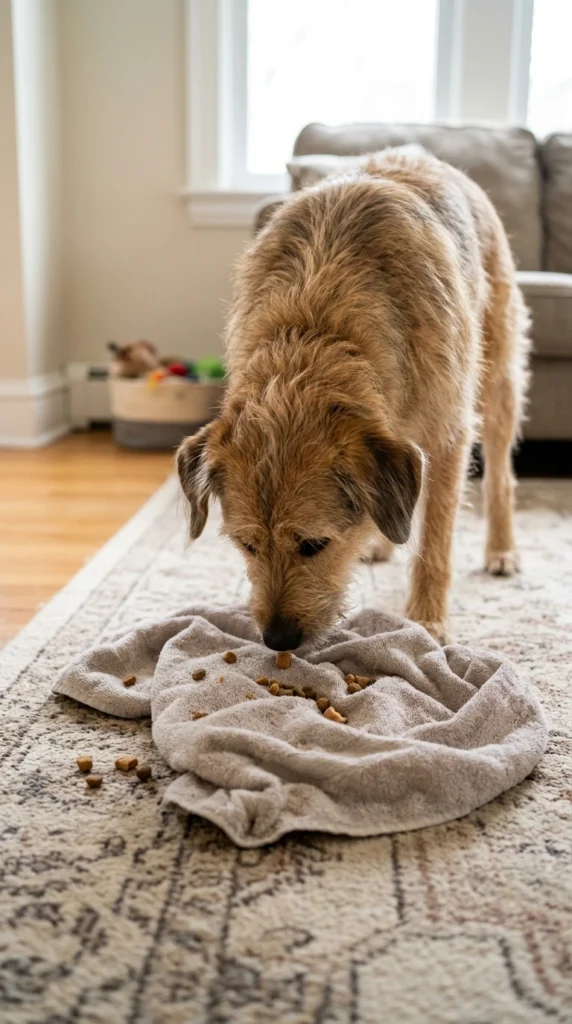
Before using a puzzle with sliders or moving parts, place a few pieces of the dog’s usual food in an open shallow dish or on a clean mat. Let the dog find them without pressure.
Avoid adding rich treats just to force engagement. Use the dog’s ordinary food when appropriate and count it as part of the meal.
3. Introduce the object with no challenge
Set the empty puzzle several feet away. Reward relaxed sniffing or a glance, then put it away. Add a treat on top of the toy rather than inside a locked compartment.
A nervous dog should be allowed to retreat. Never hold the toy in front of its face or push its muzzle into a hole.
4. Make success immediate
Place one visible food piece in an open compartment. Let the dog take it freely. Repeat until it is clear that approaching the object predicts an easy reward.
Move only one difficulty variable at a time. When food is hidden, the dog should still have a simple route to retrieve it.
5. Demonstrate a simple movement
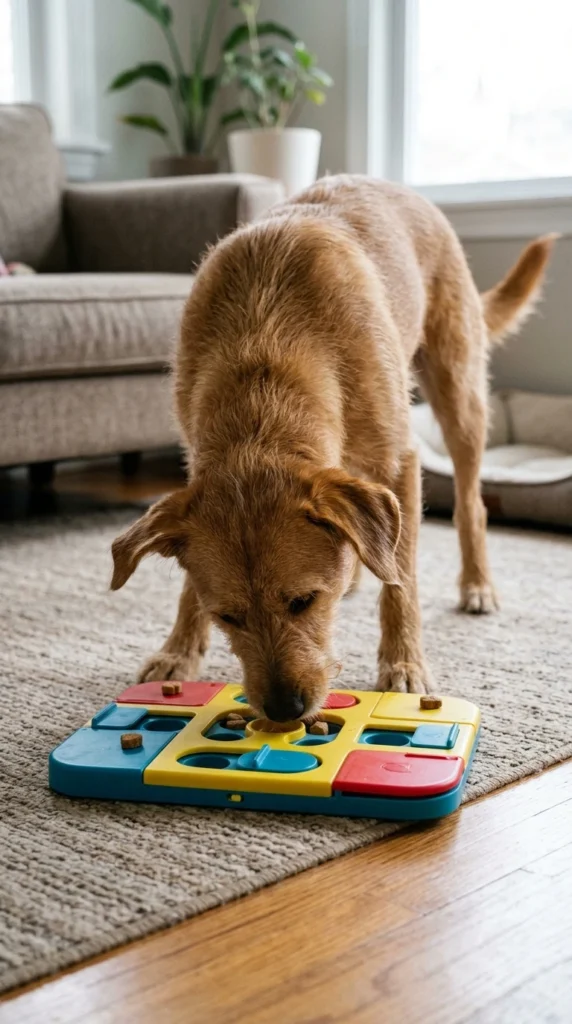
For a beginner slider, move the panel fully open yourself and allow the dog to investigate. Later leave it almost open. For a wobble toy, stabilize the toy rather than requiring large movements immediately.
Some dogs benefit from watching an owner operate the toy, but there is no need to physically push a paw or muzzle against it.
6. Shorten sessions before frustration begins
Start with a minute or two and stop after a couple of successful finds. Repeated pawing, whining, walking away or trying to chew the plastic may mean the puzzle is too hard.
Do not leave a struggling dog alone with a complex toy. Remove it calmly and offer an easier enrichment option.
7. Pick the right surface and toy size
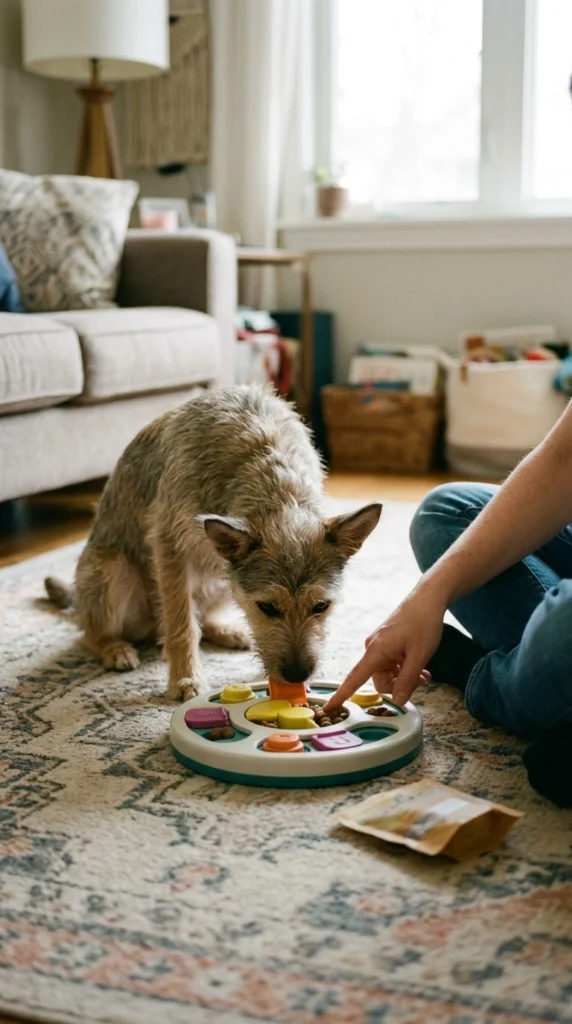
A nonslip mat stops plastic puzzles from skittering across tile. The toy should be large enough that the dog cannot swallow it, and individual pieces should not detach easily. Follow the maker’s supervision instructions.
Dogs with short muzzles, mobility difficulties or dental pain may need different shapes and heights. Ask a veterinarian if eating or chewing has changed suddenly.
8. Use alternatives to build confidence
A scatter-feeding game on a clean floor, a simple snuffle mat or a cardboard-free food search can teach the same basic idea: sniffing and finding food. Supervise and remove anything the dog tries to swallow.
Once the easy game feels familiar, return to the puzzle with fewer moving pieces and more accessible food.
9. Build a sustainable enrichment routine
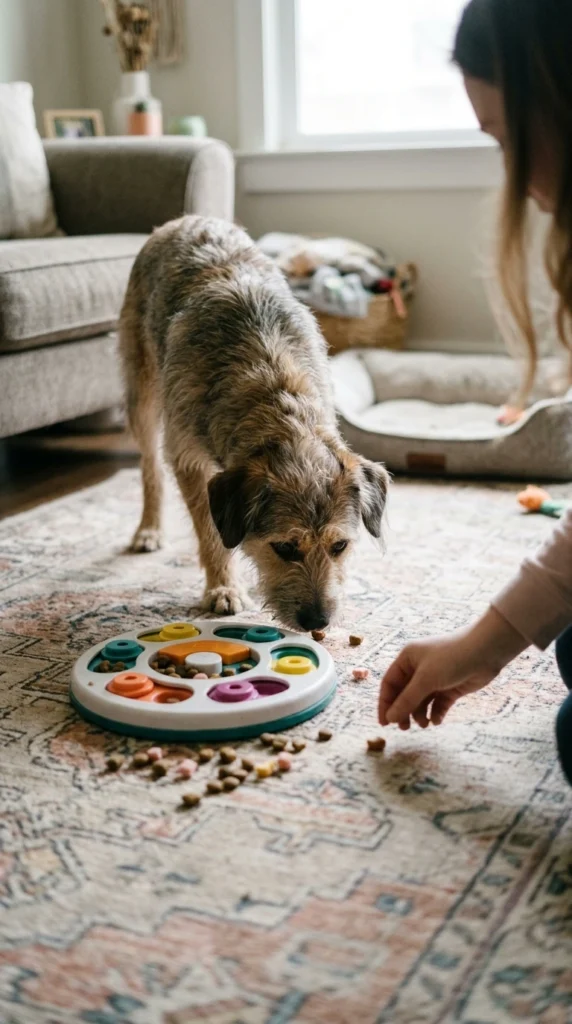
Rotate easy toys rather than presenting a new complicated device each day. Wash bowls and puzzles according to the instructions and check for cracked pieces. Watch the dog’s body language and stop if play becomes tense.
Food puzzles are a useful option, not a requirement. Walks, sniffing, social choice, play and ordinary positive training also enrich a dog’s life.
Common mistakes to avoid
- Rushing to the final step before the dog understands the easy version.
- Restraining, dragging or punishing a dog who is worried or uncomfortable.
- Ignoring a poor fit, painful paw, or another physical reason for resistance.
- Training during a stressful outing rather than in a quiet, safe setting.
Helpful resources and optional supplies
For a broader selection of owner-approved gear, visit our Recommended Dog Products page. Readers who prefer detailed learning can browse our Dog Books library. Explore the Dog Care Tools hub for the live breed-matching and age resources. These links are optional and do not replace the steps above.
For a foundation in gentle learning, read puppy socialization advice and return to easier practice whenever your dog shows stress.
Related on our site: Puppy Socialization Tips.
Affiliate disclosure: As an Amazon Associate, we may earn from qualifying purchases, at no additional cost to you. All products below are optional.
- Outward Hound Nina Ottosson Dog Brick Puzzle: A supervised enrichment option for dogs already comfortable with food games; choose an easier toy for beginners. View exact product on Amazon.
- Paw Lifestyles Dog Treat Training Pouch: A reward pouch is useful for short reward-based lessons, but an ordinary pocket also works. View exact product on Amazon.
A five-level beginner puzzle progression
This practical reference turns the advice above into manageable actions:
- Level 1: Place a little food in a visible shallow bowl next to the puzzle.
- Level 2: Put food on top of the motionless puzzle, with no lids or barriers to move.
- Level 3: Place food in a completely open compartment and allow an easy grab.
- Level 4: Leave a slider mostly open so one gentle nose push reveals the reward.
- Level 5: Add just one slightly harder movement once your dog confidently solves the easy task.
- Review: If barking or chewing begins, move back one or two levels and shorten the session.
You do not have to buy an elaborate puzzle for an effective game. Simple supervised food searches can meet the same immediate learning goal while you decide whether your dog enjoys puzzle toys.
Frequently asked questions
Why does my dog bark at a food puzzle?
Frustration, uncertainty or a moving toy may cause barking. Make the puzzle easier and reward relaxed investigation.
How long should a beginner puzzle session last?
One or two minutes can be enough for a first session; finish with a successful find.
Are food puzzles safe to leave alone?
Many puzzles contain parts that can be chewed or swallowed. Supervise and follow the manufacturer’s guidance.
Do dogs need puzzle toys to be happy?
No. Sniffing games, walks, social time, training and simple play all provide meaningful enrichment.
Final thoughts
Start with open, easy food games, reward curiosity and gradually introduce more movement without frustration. Keep the routine kind, predictable and appropriate for your dog. A few careful, comfortable steps are usually more useful than a dramatic one-day transformation. If a problem continues or feels medically concerning, your veterinarian or a credentialed reward-based professional can provide individualized help.