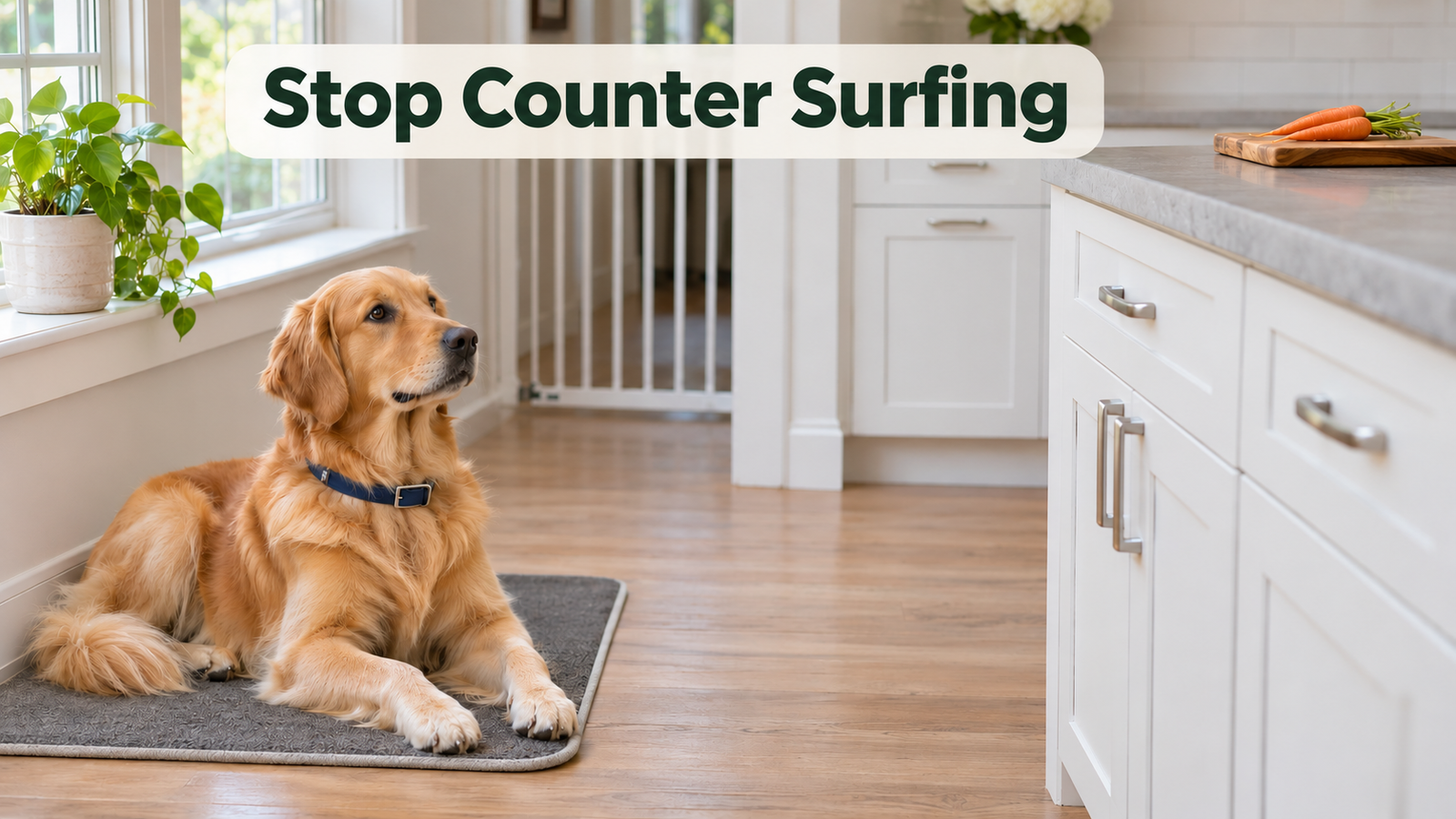
If your dog helps itself to whatever is on the counter, the fix has two parts. First, make counter surfing stop paying off: clear food away, store it properly, and block kitchen access while you cook. Second, teach your dog what to do instead, and reward it. Four paws on the floor or a relaxed spot on a mat both work well.
Everyone in the house needs to follow the same rules, and management stays in place even after training works. If your dog has already eaten something risky, skip to the section on what to do if your dog has already stolen food.
Table of Contents
Why dogs counter surf
Dogs are opportunistic scavengers, and the counter is a reliable food source. The American Kennel Club (AKC) notes that food left within reach rewards the behavior, so a dog keeps checking, and Preventive Vet adds that one successful snack can teach a dog that trying again is worth it. Big dogs can reach a counter edge with their snouts or paws, and some small dogs can jump straight up.
Punishment doesn’t help. Yelling at a dog who grabbed a sandwich ten minutes ago teaches nothing about the counter. AKC, Preventive Vet and Adoptapet all advise against it, because it can make a dog anxious or sneaky. Adoptapet also cautions against startle devices such as noisemakers and motion alarms, which don’t show a dog what to do instead and can add fear.
Start here: set up your kitchen first
Management comes first and stays in place through every training stage. Training teaches your dog what to do; management keeps it from practicing the old habit. Never leave tempting food within reach to test the training.
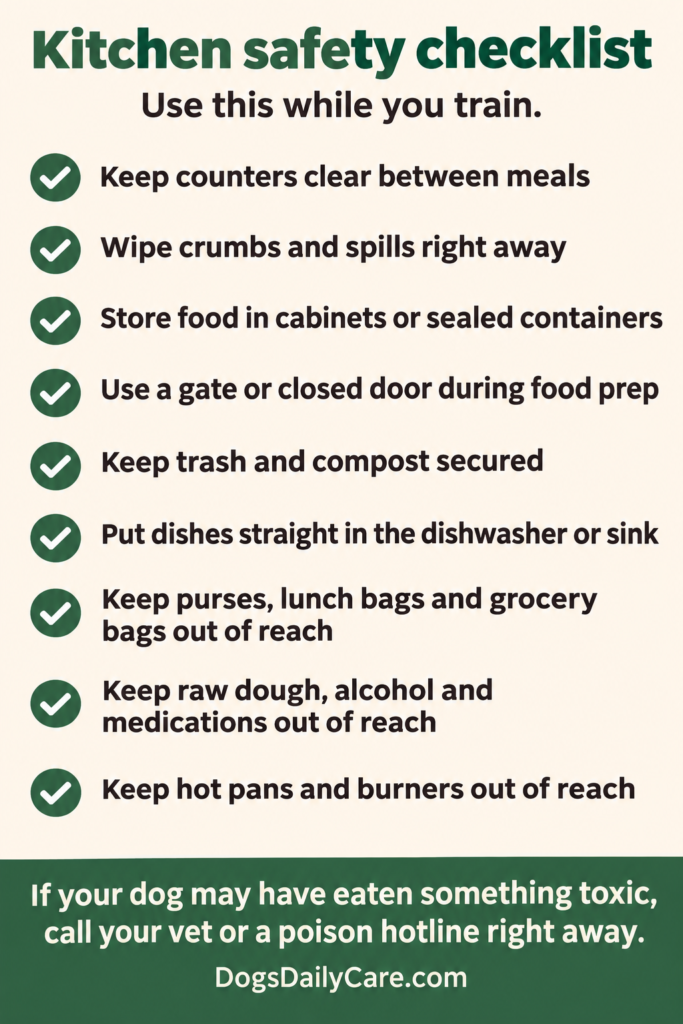
Kitchen safety checklist
- Counters are clear of food, and anything you’re using sits well back from the edge.
- Leftovers and ingredients are stored in cabinets, the refrigerator or airtight containers.
- Crumbs and spills are wiped up.
- A gate, closed door or exercise pen keeps your dog out while you cook, or a crate if your dog already likes it.
- The trash can has a secure lid or sits in a closed cabinet.
- Chairs and stools that give a small dog a path up are pushed in.
- Sugar-free gum, candy, baked goods and toothpaste are out of reach, because they can contain xylitol.
- Raw bread dough, alcohol and medications are somewhere your dog can’t get to them.
- Hot pans and burners are out of reach. Adoptapet notes that counters can expose dogs to hot surfaces.
Block access while you cook
The simplest way to prevent counter surfing during meal prep is to keep your dog out of the kitchen. A baby gate, closed door or exercise pen works, and Preventive Vet and Adoptapet both recommend this kind of blocking. Give your dog something to do on the other side; AKC suggests a food-stuffed toy or a dog-safe chew.
Use a crate only if your dog is already comfortable in it. AKC says never to use a crate for punishment or force a dog inside, since that creates a negative association. Otherwise, use a gate or closed door.
How to train your dog to stay off the counter
Pick a short marker word such as “yes” to tell your dog the exact moment it earns a reward, and use small, soft treats. Keep sessions to a few minutes, with no food out.
Step 1: Reward four paws on the floor
Stand in the kitchen with the counters clear. The moment your dog has all four paws on the floor, standing or sitting, mark and reward at floor level, which keeps its head low and away from the edge. Adoptapet’s trainer recommends rewarding four paws on the floor. If your dog also jumps on people, see our guide to stopping your dog from jumping on people.
Step 2: Teach a kitchen “place”
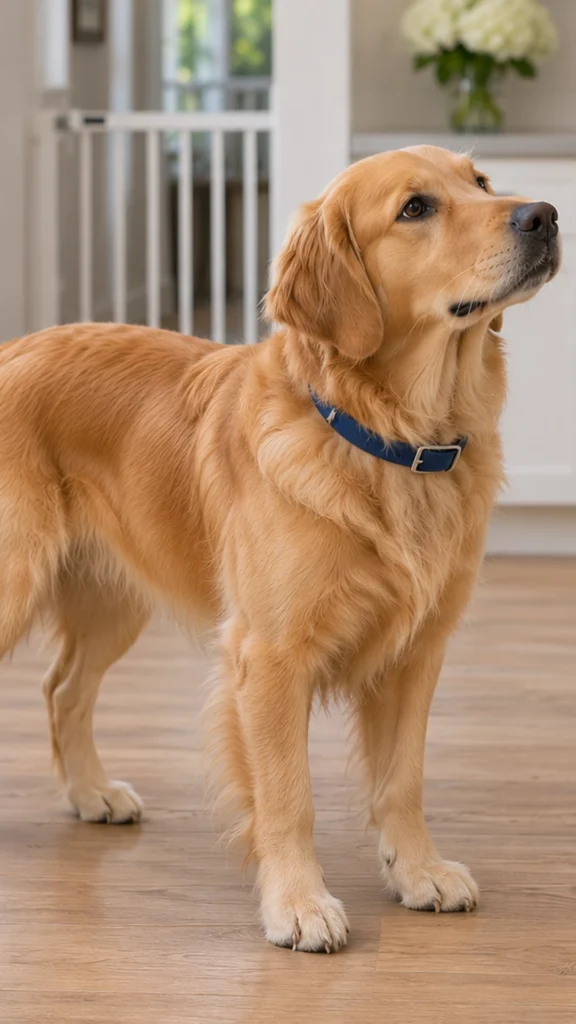
AKC recommends teaching a spot on a bed or in a crate near the kitchen: start with no distractions, reward your dog for touching or lying on it, then build duration, distance and distractions. You can toss treats onto the bed while you cook.
Our mat training guide walks through teaching “go to your mat” in stages. It was written for the doorbell, but the skill is the same. In the kitchen, place the mat where your dog can see you but can’t reach the counter.
Step 3: A quick introduction to “leave it”
“Leave it” helps if your dog grabs something you can’t control. It takes practice, and we’ll cover it in a separate guide. The basic idea, adapted from AKC’s training instructions:
- Hold a treat in your closed fist and let your dog try to get it. When your dog stops trying, mark, then open your hand, say “take it” and let your dog have that treat.
- Put a treat on the floor and cover it with your hand. When your dog stops trying for it, mark and reward with a higher-value treat from your pocket or other hand, not the one on the floor.
- Gradually lift your hand, ready to cover the treat again if needed. Once your dog reliably ignores dropped food, say “leave it” just before you drop the food, then mark and reward with the higher-value treat.
AKC recommends practicing on a leash so your dog can’t grab anything you miss.
Step 4: Add kitchen activity gradually
Once your dog settles on its mat in a quiet kitchen, add everyday activity a little at a time: opening cabinets, running water, moving around, and eventually handling food. Preventive Vet describes this as working up from boring to more tempting situations.
Keep the safety net in place at every step. While you practice with food, your dog should be on a leash you’re holding or behind a gate, with food out of reach. If your dog struggles, go back a step.
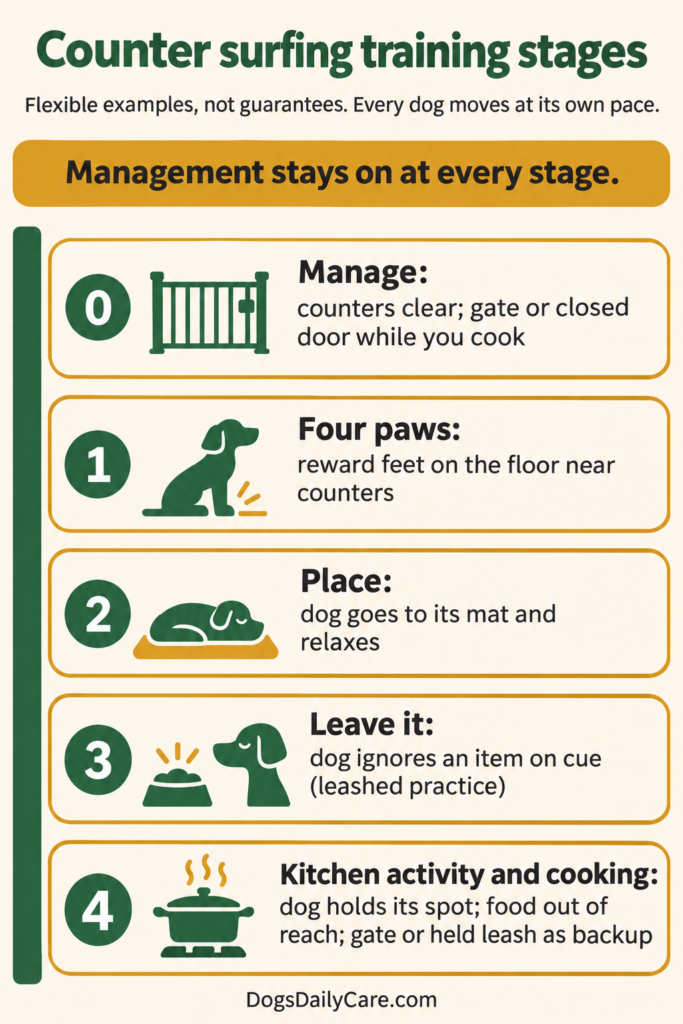
Training stages at a glance
These are flexible examples, not scientific thresholds. Every dog moves at its own pace, progress is not guaranteed, and it’s fine to repeat a stage.
| Stage | Goal | Setup | Consider moving on when (example) |
|---|---|---|---|
| 0. Manage | Stop the habit from paying off | Counters clear; gate or closed door while you cook | Never “graduate.” Keep this in place on busy days |
| 1. Four paws | Feet stay on the floor near counters | No food out; reward at floor level | Dog does it most of the time over several sessions |
| 2. Place | Dog goes to its mat and relaxes | Mat a few feet from the kitchen; no cooking yet | Dog stays on the mat briefly while you move around |
| 3. Leave it | Dog ignores an item on cue | Leashed, low-value item on the floor | Dog ignores it on cue most of the time |
| 4. Kitchen activity and cooking | Dog holds its spot during kitchen sounds, movement and meal prep | Food out of reach; gate or held leash as backup | Keep management on, even when training is going well |
Holiday cooking and guests
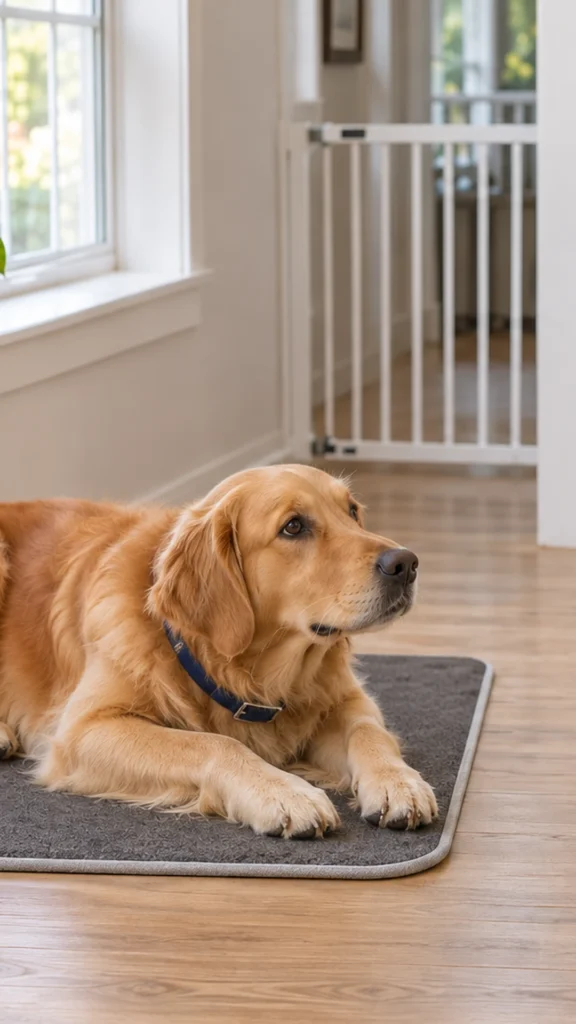
Today’s Veterinary Practice notes that holidays make it easy to leave food or drinks on a counter or coffee table. Before guests arrive, set up the gate and have a stuffed toy ready. While you cook, keep your dog behind the gate or on its mat, ask one person to keep an eye on it, and keep dough, desserts and drinks well back from edges.
Tell guests the rules up front: no feeding from the table and no plates left within reach. If greetings are the harder part, try our calm greeting routine.
If counter surfing isn’t improving
| What you see | A likely reason | What to try |
|---|---|---|
| Surfs only when you’re out | Your dog has chances when nobody’s watching | Block access whenever you can’t supervise |
| Keeps jumping up while you cook | Too much temptation, too soon | Go back a step, add distance, and give a stuffed toy |
| Ignores the mat | The reward isn’t worth it, or distractions are too high | Use better treats, shorten the stay, reduce distractions |
| Progress keeps slipping | Household rules aren’t consistent | Agree on and write down the rules |
If your dog has already stolen food
Most stolen food is a training problem, but some is a medical one.
When to call for help right away
Treat it as an emergency if you think your dog may have eaten:
- Anything with xylitol, a sweetener in some sugar-free gum, candy, baked goods and toothpaste. The ASPCA says it can cause low blood sugar and liver damage. Pet Poison Helpline says to check products labeled sugar-free, sugarless, no sugar added or keto.
- Grapes, raisins or currants, including in baked goods. Pet Poison Helpline’s kitchen toxins page says there is no known toxic dose, so any ingestion should be considered potentially toxic. Do not wait to see whether symptoms develop.
- Chocolate, especially dark or baking chocolate.
- Onions, garlic or alcohol.
- Raw yeast dough, which can keep rising in the stomach and also produces alcohol.
- Medications left on a counter.
- A swallowed object, such as a cooked bone or corn cob. These can cause choking or an intestinal blockage. Contact your veterinarian promptly even if your dog seems well. Cornell University College of Veterinary Medicine identifies corn cobs and bones as common foreign bodies. If your dog is struggling to breathe, seek emergency veterinary care immediately.
What to do
- Remove any remaining food so your dog can’t eat more.
- Note what your dog ate, roughly how much, and when. Keep the packaging or take a photo of the ingredient list.
- Call your veterinarian or an emergency clinic, or call a poison hotline. Don’t wait for symptoms.
- ASPCA Poison Control: (888) 426-4435, available 24/7. A consultation fee may apply.
- Pet Poison Helpline: 855-764-7661. A per-incident fee applies.
- Do not try home remedies or make your dog vomit unless a veterinarian or poison expert tells you to.
If it was an ordinary bite
Not every stolen bite is an emergency. If you know exactly what your dog ate and it was a small amount of plain, boneless, unseasoned cooked chicken, for example, it may not require emergency treatment. The amount, ingredients and your dog’s size and health still matter. Contact your veterinarian if you are uncertain about the food or quantity, or if your dog develops vomiting, diarrhea, unusual tiredness or unsteadiness. If there is any possibility of a toxin or swallowed object, call promptly rather than waiting for symptoms.
When to get professional help
Consider a certified trainer, behavior consultant or veterinary behaviorist if counter surfing continues despite consistent management and training, your dog eats almost anything it can get, guards food or objects, or has needed medical care after eating something it shouldn’t have.
FAQs
How long does it take to stop counter surfing?
It depends on how long the habit has existed and how consistent you are. AKC says many dogs improve significantly within weeks when management and training are combined, but there are no guarantees.
Why does my small dog jump on the counter?
Some small dogs can jump straight up. Remove routes such as stools and chairs, and reward four paws on the floor.
Do I need to keep the gate up forever?
There’s no set timeline. Many owners keep some management in place during busy cooking. That is editorial advice, not a research finding.
Final Thoughts
Counter surfing fades when it stops paying off. Keep food out of reach, block the kitchen while you cook, and reward what you want to see, whether that’s four paws on the floor or a calm spot on the mat. Consistency matters most, and everyone in the house needs to follow the same rules. Training may improve things within weeks, but there are no guarantees, so keep management in place. Your next step is simple: run through the kitchen checklist today, then spend two minutes rewarding your dog for standing calmly while the counters are clear.